
This Simple Change Helped Triple Blood Pressure Control in Bangladesh
How digital records improved care for hundreds of thousands of patients

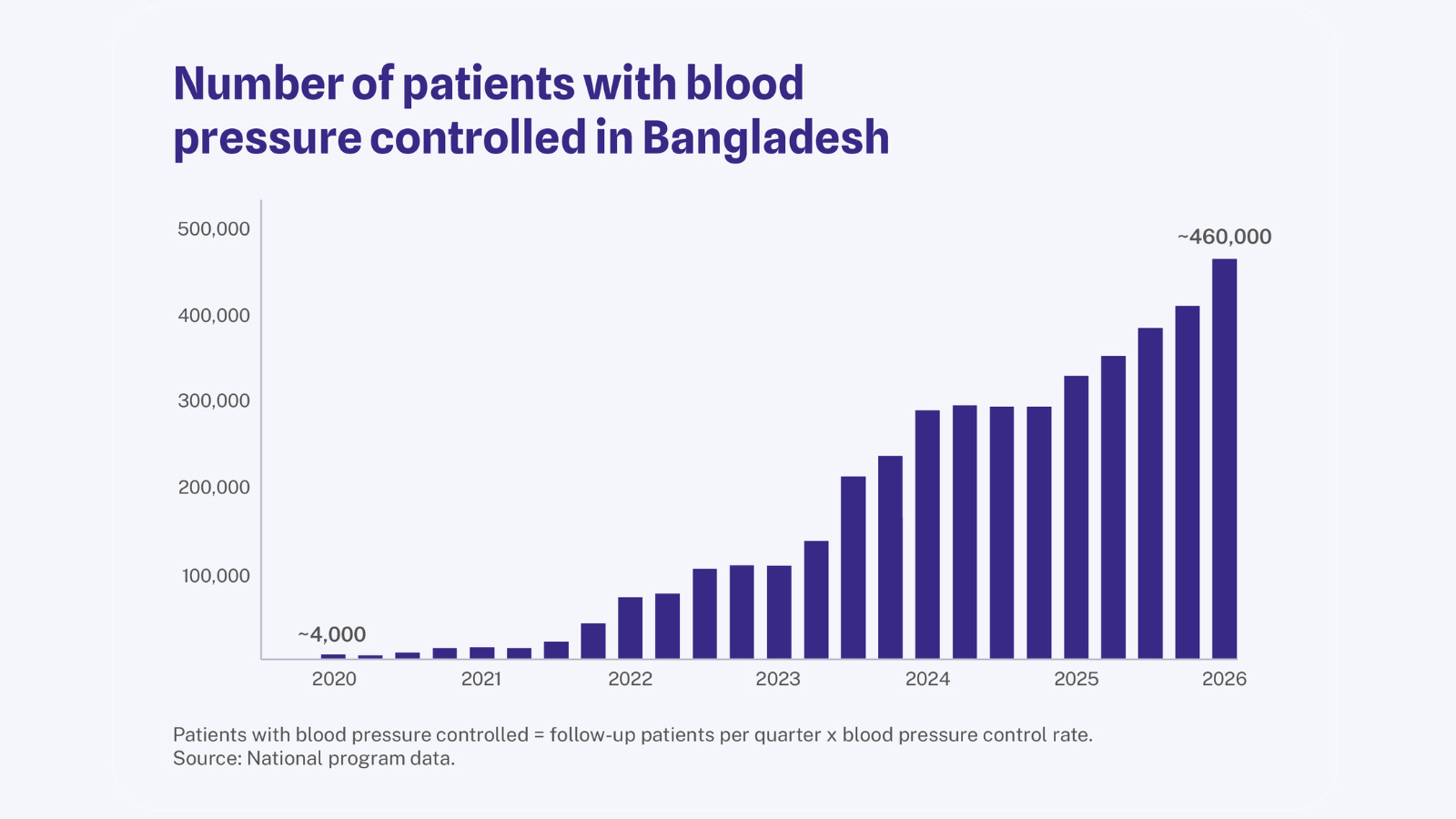
Last week I wrote about 76 million reasons to treat high blood pressure—the lives the world could save over the next 25 years if countries close the gap in hypertension control. Bangladesh is one of the clearest examples of what beginning to close that gap looks like. The blood pressure control rate there tripled in four years, from 20% to 60%, and the number of patients with blood pressure controlled rose from about 4,000 to more than 460,000.
How did it happen? A simple change, repeated by thousands of health workers: record results in a digital system and use them to track progress.
For decades, primary care in Bangladesh ran on paper. A health worker in a crowded clinic saw as many as 300 patients a day, spending a couple of minutes per patient and navigating a stack of handwritten records. When a patient missed a follow-up visit, no one knew until a stroke or heart attack brought them back. You can’t manage what you can’t see, and paper records hid almost everything. (As in most countries, the paper records were day-specific, not patient-specific, so there was no reliable individual patient record.)
Digital records changed that. In 2018, our team set out to build an app that helped health workers treat more patients and improve care. The result was the Simple app, which is free, open-source, and hosted by governments. Although a digital screen isn’t necessarily better than paper by itself, digital data enables the creation of worklists for health workers, dashboards for managers and clear signals about the need for policy or program changes for policymakers.
The worklist shows each health worker which patients are overdue for a visit to the health center. Because hypertension doesn’t usually cause symptoms until the first heart attack or stroke (hence the name ‘silent killer’), making sure patients are consistently taking their medications, checking in with their clinic, and keeping their blood pressure under control is a challenge. When Bangladesh’s program began pulling overdue patients into a daily call list, health workers could reach out before a missed visit became a missed year. In six months, the share of patients lost to follow-up fell from 50% to 26%.
The dashboard shows managers where the program is working and where it isn’t. Program leaders in Bangladesh could see, facility by facility and month by month, which clinics reached their patients, giving them the ability to take quick action to address gaps. This is the logic of HEARTS360, the free, open dashboard framework Resolve to Save Lives built based on WHO’s HEARTS technical package. It doesn’t requires a particular app and teams have built it in DHIS2, in Power BI and even in Excel.
The aggregated data also show policymakers whether the national program is moving the needle overall. Bangladesh’s Ministry of Health and the National Heart Foundation could watch control rates climb across nearly 700 facilities and set targets accordingly.
In Ethiopia, the same approach increased patient retention from 52% to 76% in 18 months. In Sri Lanka, control rates rose from 50% to 68% in a year.
Although medication supply has remained a challenge in Bangladesh, the country has made substantial progress implementing the HEARTS strategy, which consists of a simple protocol, regular drug supply, team-based care, patient-centered services, and an effective information system. Bangladesh has an excellent treatment protocol and is making steady progress with team-based care and free, patient-friendly services.
Improved hypertension control can be a pathfinder for improved primary care. HEARTS depends on evidence-driven, team-based, patient-friendly care, and these principles are important for all care, especially for conditions that need long-term treatment. Simple provides all-too-rare evidence that a digital tool, if and only if it’s developed with a true focus on the end user, can enable rapid improvements in both quality and quantity.
Strong primary care works because of simple things done well. A visit becomes a record, a record becomes a worklist, and a worklist becomes a patient reached before a stroke. Bangladesh made progress without new science or complex technology. Every bar on the chart above represents people alive and healthy because thousands of health workers could finally see who needed care.
Bravo! Common sense applied to available resources, with actions driven by local monitoring.
Rich Schieber, MD